Overview
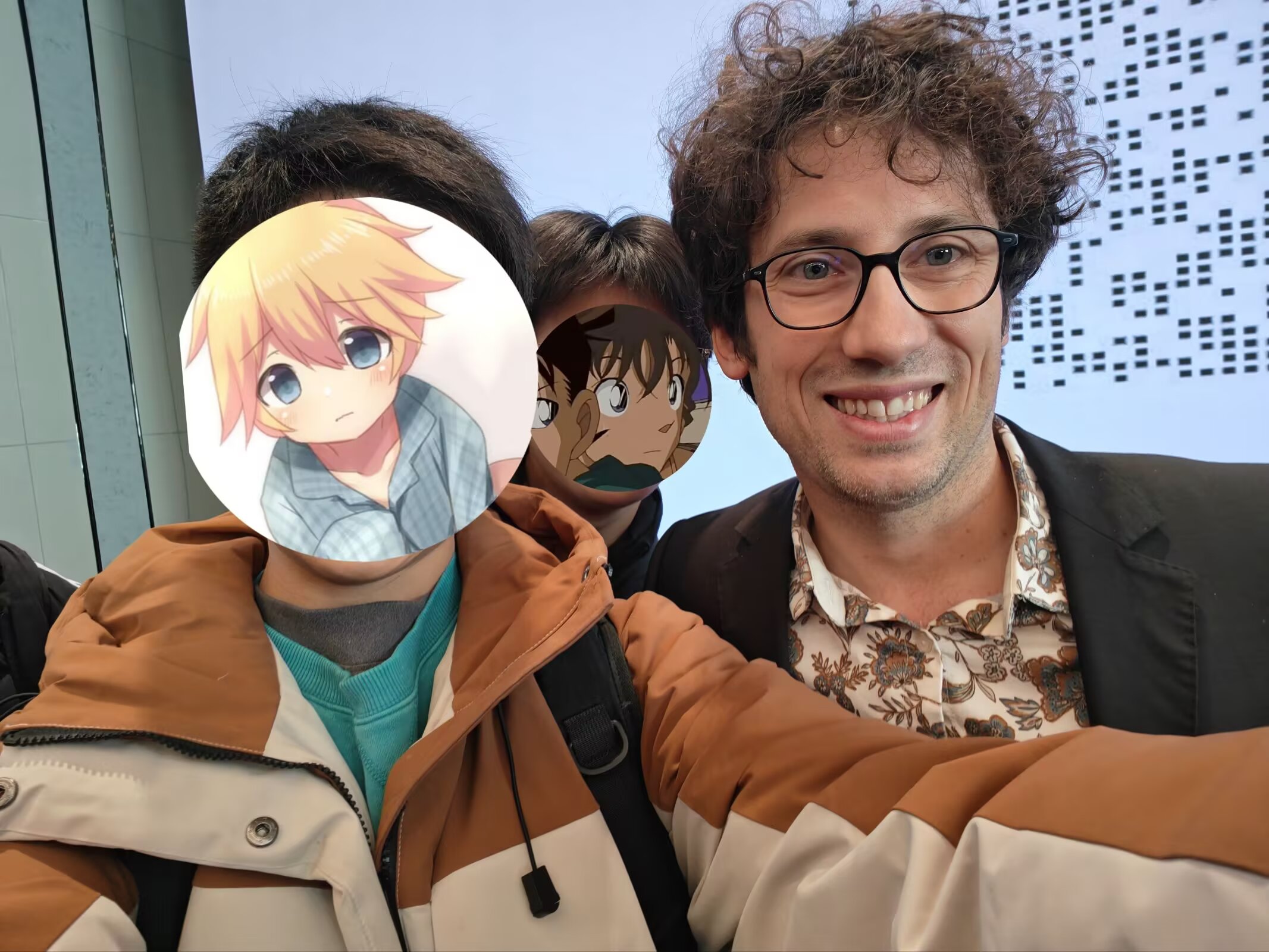
I cut class to attend a lecture by Fields Medalist Hugo Duminil-Copin and was the first to rush forward for a photo afterward—a completely successful fan moment! Initially, I thought I would not understand anything and was just going to observe, but Hugo's presentation was surprisingly accessible, which is also closely related to his choice of topic.
Detailed Summary of the Lecture Content
The lecture, while initially confusing to me, proved to be an illuminating exploration of combinatorial probability and statistical mechanics, primarily focusing on Self-Avoiding Walks (SAW), not the more general concept of a random walk.
1. Structure and Initial Analogy
The beginning of the talk was framed using an accessible analogy, which I initially summarized as:
The presentation was structured a bit like teaching sequences to high school students, where you look for a pattern step by step, and then are told the pattern you found is wrong, which served as an introduction to the difficulties of the random walk.
This method served to illustrate the inherent challenges and non-obvious nature of finding closed-form solutions in probability theory, especially concerning the intricacies of walks on lattices.
2. The Focus: Self-Avoiding Walks (SAW)
While I first mistook the subject for general random walks, the core of the discussion was the Self-Avoiding Walk (SAW), a critical model in statistical mechanics for polymer chains.
| Concept | Explanation |
|---|---|
| Self-Avoiding Walk (SAW) | A sequence of moves on a lattice that does not visit the same site more than once. It is a fundamental model for the shape of a long-chain polymer in a solvent. |
| Random Walk | A mathematical formalization of a path that consists of a succession of random steps, typically allowing repetition of sites. |
3. Key Concepts and Results Discussed
HDC moved from general concepts to specific, groundbreaking results, highlighting the influence of geometry and symmetry on problem solvability.
The Space-Filling Property
In the earlier part of the lecture, HDC emphasized a crucial property of SAW: Space-Filling.
- Concept: He discussed how, under certain conditions, supercritical self-avoiding walks are space-filling. This property is foundational to understanding the macroscopic behavior of the walks.
- Reference: This topic relates to his work: H. Duminil-Copin, G. Kozma, and A. Yadin, “Supercritical self-avoiding walks are space-filling,” Probability Theory and Related Fields, 2014. (arXiv:1110.3074)
The Honeycomb Lattice Result
The central focus of his talk, and perhaps the main 'hook' for the audience, was the analytical solution for the connective constant of the honeycomb lattice.
- Progression: The lecture progressed from analyzing the random walk on a square lattice to the SAW on a honeycomb (hexagonal) lattice.
- Groundbreaking Result: HDC spoke at length about his result for the honeycomb lattice, which is currently "the only determined exact analytic expression for a 2D case."
- Connective Constant: This is the exponential growth rate of the number of SAWs of length n on a given lattice.
- Reference: This result was published in a top-tier journal, reflecting the significance of the work: H. Duminil-Copin and S. Smirnov, “The connective constant of the honeycomb lattice equals ,” Annals of Mathematics, 2012. (arXiv:1007.0575)
- Confidence: The fact that he presented an Annals of Mathematics result simply as an attention-grabbing "hook" demonstrates the confidence one would expect from a Fields Medalist.
The Role of Geometry and Symmetry
HDC then addressed the difficulty of the square lattice problem, explaining "why his method is not viable for the random walk on the square lattice," referencing the "influence of symmetry and other properties."
4. The Methodological Takeaway
The concluding part of the lecture shifted away from "hardcore content" and focused on broader mathematical philosophy.
"Behind this, there wasn't much hardcore content, just discussions about problem-solving mindsets."
- Analogy as a Theme: The overarching theme was the use of Analogy as a key problem-solving methodology. He emphasized drawing connections between different mathematical and physical systems.
- Final Note: He brought up Fractals at the end, primarily drawing an analogy between fractal properties and the previously discussed SAW characteristics like the space-filling property and symmetry.
5. Post-Lecture Interaction and Missed Opportunities
I missed the formal Q&A session. I had intended to ask a few questions privately, but HDC stated he did not have time and suggested I contact him via email instead. Nonetheless, I successfully achieved my goal of getting the joint photograph, which left me very satisfied.
6. Observations and Anecdotes (Easter Eggs)
- French Mathematical Notation: HDC uses traditional French mathematical notation, employing a comma (
,) as the decimal separator. This initially caused significant confusion. - French-English: During the lecture, HDC spelled Object as "Objet," reflecting a typical French-English linguistic crossover.
- Educational Commentary: During the subsequent Q&A, a discussion about mathematics education in China and France led HDC to possibly mention the Jiang Ping incident. He seemed to have only partial or incomplete knowledge of the event.
Contextual Discussion (From the Comments Section)
The lecture sparked a brief discussion that provided important context regarding HDC's overall contributions, particularly highlighting the distinction between his work known to mathematicians and that known to physicists.
- Perspective from Computer Science (My view): As someone primarily focused on Computer Science, my key recognition of HDC's work lies in his "application of statistical physics ideas to solve problems in probability theory," specifically mentioning "using the parafermionic operator to solve the honeycomb SAW problem," which is an excellent example of the Analogy he stressed in the lecture.
- Perspective from Physics: A commentator noted that for physicists, HDC's "most important contribution is proving the non-existence of the 4D fundamental theory." This highlights the breadth of his influence, extending into constructive quantum field theory, an area I was not familiar with.
| Concept | Explanation |
|---|---|
| Parafermionic Operator | A complex mathematical object used in conformal field theory and statistical mechanics that helped provide the exact solution to the honeycomb lattice SAW problem. It is a powerful example of how tools from physics can solve purely mathematical problems. |
| 4D Theory | A specific model in quantum field theory involving a scalar field . Its non-existence in four dimensions (proven by HDC and others) is a crucial, high-impact result in fundamental physics. |