Overview
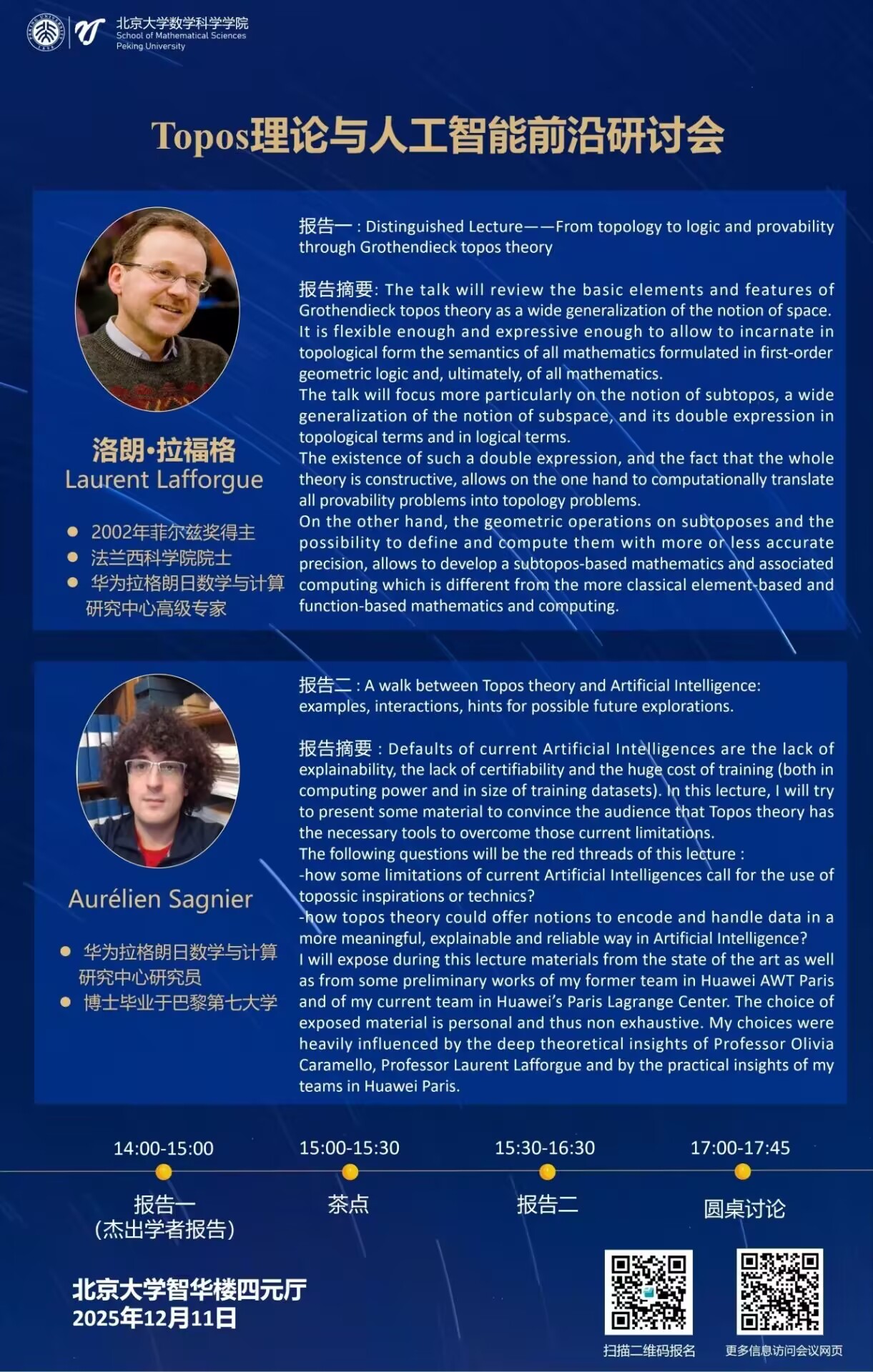
This entry summarizes a highly foundational and forward-looking academic seminar I occasionally noticed, titled "Topos Theory and the Frontier of Artificial Intelligence," held at the Zihua Fourth Yuan Hall, Peking University, on December 11, 2025. The event featured Fields Medalist Laurent Lafforgue and Aurélien Sagnier from the Huawei Paris Lagrange Center.
My deep interest in the topic led to an extensive personal analysis, which focused on the revolutionary potential of using Topos Theory—a domain bridging logic and geometry—to solve the fundamental flaws of current AI: the lack of explainability and certifiability. Specifically, my inquiry focused on understanding the theoretical breakthrough this approach offers compared to traditional statistical learning, particularly the role of the Coproduct () in enabling a traceable, modular form of reasoning.
1. The Foundational Seminar: Topos Theory and AI
A. Event Details
- Title: Topos Theory and the Frontier of Artificial Intelligence
- Date & Location: December 11, 2025, Zihua Fourth Yuan Hall, Peking University
- Schedule Highlights:
- 14:00-15:00: Lecture I (Laurent Lafforgue)
- 15:30-16:30: Lecture II (Aurélien Sagnier)
- 17:00-17:45: Panel Discussion
B. Lecture I: Distinguished Lecture – Laurent Lafforgue
The first lecture, delivered by Laurent Lafforgue (2002 Fields Medalist, Senior Expert at Huawei Lagrange Center), established the foundational mathematical framework.
-
Title: Distinguished Lecture — From topology to logic and provability through Grothendieck topos theory.
-
Abstract (Original Text):
"The talk will review the basic elements and features of Grothendieck topos theory as a wide generalization of the notion of space. It is flexible enough and expressive enough to allow to incarnate in topological form the semantics of all mathematics formulated in first-order geometric logic and, ultimately, of all mathematics. The talk will focus more particularly on the notion of subtopos, a wide generalization of the notion of subspace, and its double expression in topological terms and in logical terms. The existence of such a double expression, and the fact that the whole theory is constructive, allows on the one hand to computationally translate all provability problems into topology problems. On the other hand, the geometric operations on subtoposes and the possibility to define and compute them with more or less accurate precision, allows to develop a subtopos-based mathematics and associated computing which is different from the more classical element-based and function-based mathematics and computing."
-
Key Concepts (My Analysis): The core idea is that Grothendieck Topos Theory provides a framework for encapsulating the semantics (meaning) of mathematics in a topological/geometric form. Crucially, the theory is constructive, allowing provability problems to be computationally translated into topological problems.
C. Lecture II: A Walk between Topos Theory and AI – Aurélien Sagnier
The second lecture, delivered by Aurélien Sagnier (Researcher at Huawei Lagrange Center), connected the abstract theory to contemporary AI challenges.
- Title: A walk between Topos theory and Artificial Intelligence: examples, interactions, hints for possible future explorations.
- Abstract (Paraphrased Core):
The speaker highlights the defaults of current Artificial Intelligences: the lack of explainability, the lack of certifiability, and the huge cost of training. The lecture attempts to present material convincing that Topos theory has the necessary tools to overcome these limitations. The central question is: How can Topos theory offer notions to encode and handle data in a more meaningful, explainable and reliable way in Artificial Intelligence?
2. Theoretical Analysis and Breakthrough Potential
A. The Definition of Topos and Its Role in Explainability
A Topos is a special kind of category that functions as a universe for mathematics, possessing both a complete logic structure (Internal Logic) and a generalized geometry structure. The breakthrough is that Topos Theory is proposed as a way to create explainable AI because it is the essential bridge between logic and geometry. By representing data within a Topos, an AI’s decision ceases to be a mere statistical association and becomes a provable, logically structured statement.
B. Topos AI vs. Traditional Statistical AI (The Paradigm Shift)
| Feature | Traditional (Deep) Learning AI | Topos Theory AI |
|---|---|---|
| Data Representation | Vectors / Tensors (pure numerical values) | Objects and Structures within a Topos (semantic entities) |
| Model Goal | Function Approximation / Minimizing Loss Statistical Association | Structure-Preserving Maps / Proof Generation Logical Necessity |
| Output Nature | High-Probability Prediction | Certifiable and Provable Conclusion |
C. The Initial Focus: The Role of Coproduct (Disjunction)
I was particularly drawn to the potential of the Coproduct ()—the categorical dual of the Product—as a crucial element for achieving explainability.
-
Concept Explanation: Coproduct ()
- In Topos Internal Logic, the Coproduct corresponds to Disjunction (Logical OR, ).
- It is a foundational structure that maintains the separability of the combined objects (like a Disjoint Union).
-
Initial Rationale for Coproduct's Importance: I hypothesized that the Coproduct's ability to create a clear, non-overlapping decision branch (either A or B) would be key to explainability. If an AI's output is derived via a Coproduct, the explanation for the output can be definitively traced back to the specific, separate knowledge module it originated from, avoiding the ambiguity of typical neural network contributions.
3. Post-Seminar Reflection and Future Inquiry
A. Beyond the Coproduct: The Power of Complete Topos Structure
Following a fruitful discussion with Senior Zeng, I realized that while the Coproduct is fundamental, it is only one necessary part of the Topos structure's true power. The ultimate breakthrough of Topos AI lies in the synergy of its complete set of foundational structures, enabling a fully logical universe for computation:
| Critical Topos Structure | Role in AI Breakthrough |
|---|---|
| Subobject Classifier () | Provides a structured true value for propositions. This is essential for the AI to give contextualized and structured reasons for its decisions. |
| Internal Logic | Ensures that all AI operations are a verifiable proof process under a consistent, constructive logic. |
| Morphisms (Arrows) | These structure-preserving maps redefine the learning process as finding the structure-preserving transformations between data concepts. |
| Subtoposes | Allows for the natural creation of modular, abstract knowledge compartments within the AI, facilitating high-level, interpretable reasoning. |
B. A Personal Disclaimer
It is with great regret that I was unable to attend this highly significant seminar in person. All the analyses and conceptual linkages outlined above—particularly concerning the Coproduct, the other structural components, and the overall paradigm shift—are purely preliminary theoretical speculation and initial stream-of-consciousness thoughts generated from the seminar abstracts and subsequent self-study. I have not yet had the opportunity to attend any formal lectures or read definitive literature on the application of Topos Theory to Artificial Intelligence. This fragment merely serves as a record of an intense, self-guided exploration into what I believe could be the next mathematical foundation for reliable AI.