Overview
This fragment uses the fictional “Zermelo-Hessian-Kan Program” as a vehicle for satire. It was originally written in response to classroom experiences with a high-school psychology teacher whose style felt arbitrary, overconfident, and insensitive to students’ perspectives.
The mathematical packaging is intentionally excessive: Kan extensions, critical points, and axiomatic language are used to build a mock theory of “absolute will.” The target is not mathematics itself but the rhetorical posture of authority. The piece should therefore be read as a private comic construction among classmates, not as a literal academic or personal accusation.
Introduction
The Zermelo-Hessian-Kan (ZHK) Program is a grand mathematical and physical framework established by Professor Zhu Hongkai in the mid-2020s (specifically in September 2023). This program not only attempts to unify the three pillars of pure mathematics (foundations of set theory, analysis, algebraic topology), but also establishes a meta-theory to explain social interaction, power structures, and the definition of truth on this basis. Its core lies in using the rigidity of mathematical structures to demonstrate how "subjective will" can legitimately collapse into "objective truth." Professor Zhu Hongkai also won the Fields Medal in 2026 for this program. The meaning of ZHK includes not only the abbreviation of Professor Zhu Hongkai's name, but also the theories of three major mathematicians he mainly integrated (Zermelo, Hessian, Kan). Following the Erlangen Program, which integrated several major branches of geometry, and the Langlands Program, which integrated major fields of mathematics such as analysis, algebra, and geometry, the Zhu Hongkai Program further integrated proof theory, category theory, as well as sociology, psychology, ethics and other disciplines outside mathematics, achieving an amazing interdisciplinary research. Zhu Hongkai was therefore invited to give a "one-hour report" at the ICM Congress.
1. The System: Transfinite Induction and Canonical Axiomatization (Zermelo)
In the traditional ZFC axiom system, truth relies on the independence of logical deduction. The ZHK Program points out that this independence is the source of inefficiency. The System (Zhu-Zermelo System) is an "Anthropic Reconstruction" of Zermelo set theory. Professor Zhu mainly adopted Zermelo's ideas in proof theory and axiomatic set theory. The ZFC theory established by Zermelo, as the most classic axiomatic system of set theory, is often criticized for the unprovability of many theorems in it. However, Professor Zhu believes that as a mathematical classicist, he firmly agrees that "what most people recognize is the truth," so ZFC is an excellent system. For example, the view that "students should respect teachers; laughing is disrespectful to teachers" is widely recognized and is regarded as the First Axiom in the ZHK Program.
1.1 The Axiom of Canonical Choice
The traditional Axiom of Choice asserts the existence of a function that selects an element from a family of non-empty sets. In the System, the choice function is endowed with ethical attributes. Define the universal set as all social interactions and academic assertions.
Among them, the operator does not depend on the intrinsic properties of , but on the preferences of the definer (Professor Zhu Hongkai). This means that among a set of views, the element defined as "canonical" or "universally recognized truth" does not emerge naturally, but istransfinitely chosen.
Corollary 1.1 (Invariance of Respect):
Let be the binary relation " respects ". If is the definer (Professor Zhu Hongkai), then for all , the relation must hold identically. When there is a counterexample (such as showing a smile with ), the system does not revise the relation , but directly revises the set :
That is, no longer belongs to the domain of discussion. This effectively solves Russell's paradox—the set containing all those who do not respect the definer does not exist, because they will be directly removed from the universe . This logic also perfectly adapts to Professor Zhu's absolute requirement for "respect". Any "disrespectful" behavior that violates his will will be directly excluded from the scope of discussion, and even suffer subsequent implicit suppression.
1.2 Topological Closure of Gödel's Loophole
Gödel's Incompleteness Theorems point out unprovable true propositions within a consistent system. The System introduces the "Belief Closure" operator .
This approach fills the "incompleteness gap" in logic with "axiomatic singularities". Any rule that cannot be proven through logical deduction (such as "must express gains", "no eating at this moment") will instantly collapse into an axiom that does not require proof as long as it conforms to the will of the definer (Professor Zhu Hongkai). This is Professor Zhu's core solution to the "unprovability" of the ZFC system—following the "canonical principle", for unprovable propositions, as long as they are "canonical" (i.e., conform to his personal will), they are included in the axioms without proof. It can be said that he "perfectly solved" the biggest problem of proof theory using sociological methods, boldly denying the core connotation of Gödel's Incompleteness Theorems, and placing personal will above logical axioms.
2. The Mechanism: Bordered Hessian Matrix and Critical Singularity (Hessian)
The System establishes the static structure of truth, while the Mechanism deals with dynamic interactions, especially the resolution ofDissent. This is mainly based on the Bordered Hessian Matrix in differential geometry and optimization theory. Professor Zhu mainly adopted Hessian's contributions in the field of analysis. The bordered Hessian matrix is a method to determine whether the extreme value obtained by the method of Lagrange multipliers is a local maximum or a local minimum. However, since the method of Lagrange multipliers is a necessary condition for extreme values, and the bordered Hessian matrix is only a sufficient condition for judgment, the nature of many results after the combination of the two is still undecidable or even "meaningless". This inspired Professor Zhu to leave considerable flexibility for his program, or what is called "subjective initiative"—when a certain assertion is recognized by most people and by him, meeting the "canonical" condition, the Zermelo theory is adopted to axiomatize it; if his view is opposed by most people, he ignores the "" and enters the "" scheme to deal with it, considering the other party's view as "undecidable" or even "meaningless", and thus "wrong", refusing to listen to it in any form.
2.1 Subjective Initiative of Lagrange Multipliers
Consider the social utility function and the constraint condition (such as the time constraint or the physiological constraint ). Construct the Lagrangian function:
The key here is the multiplier . In standard mathematics, is the shadow price of the constraint; in the ZHK Program, is the "Anger Coefficient". When the external constraint tries to limit the subject function (such as someone reminding him of overtime class), the system does not solve for the optimal solution, but dynamically adjusts . The real-world mapping of this mechanism is particularly distinct: just like when Zhu Liyuan kindly reminded him that "the class has been overtime for 5 minutes", he only replied: "So what?" and recorded her name for subsequent academic suppression, regarding the reminder of external constraints as an insult to his own will, and completely eliminating the effectiveness of the constraints by infinitely amplifying the "Anger Coefficient".
2.2 Singularity Judgment and the "Meaningless" Space
To judge the nature of critical points, it is necessary to calculate the determinant of the bordered Hessian matrix :
In ZHK dynamics, the elimination of dissent is not through refutation, but through Singularization. When facing a challenge, the definer (Professor Zhu Hongkai) adjusts the second derivative (i.e., the firmness of his own views), making enter a Degenerate State, that is, the discriminant fails or becomes uncertain.
This corresponds semantically to the operator:
When outputting "So what?", it actually projects the other party's arguments into the Null Space of . In this subspace, the logical metric is zero, and any causality fails. The other party's assertion is neither true nor false, but analytically meaningless. This mechanism ensures that even in the case of violating common sense (such as physiological needs ), the system can still maintain stability, because all forces that violate the constraints are introduced into an infinitely deep potential well. This "meaninglessness" treatment is essentially a mathematical disguise for Professor Zhu to avoid dissent and maintain personal authority, dismissing all opposing voices as "logically invalid", thereby achieving absolute discourse monopoly.
3. The Extension: Radical Left Adjoint and Global Truth Coverage (Kan Extensions)
This is the crown of the ZHK Program, using category theory to generalize personal will into universal laws. Here we introduce Ayaz Hafiz's algebraic geometric interpretation of the current space-time structure, especially the constructive nature of the Left Kan Extension. The "" uses Kan's contributions in algebra and category theory to extend his personal will to all concepts. Because Professor Zhu described himself as "an impulsive person", "so I do what I think, which is also my belief", and he is a radical leftist, so he only adopted the Left Kan Extension (), which is consistent with the assertion of mathematician Emily Riehl: "All concepts are Kan extensions." However, in the ZHK Program, all concepts must be extensions of Professor Zhu's personal will.
3.1 Ontology of Categorical Setting
Three categories are set:
-
Category (Core Self): Contains only a single object (the definer Professor Zhu Hongkai himself) and the identity morphism.
-
Category (Environment): The real physical world, including objects such as the audience, time, restaurants, conferences (such as ICM Congress participants, conference time, dining arrangements, etc.).
-
Category (Values): The category of value truth, whose core values are all determined by the will of the definer.
The definer has an internal functor , mapping himself to Absolute Value. There is also an embedding functor , representing that the definer exists physically in the real world.
The question is: How to extend the internal value to the entire real world through the only single-point existence ? This is exactly solving the Left Kan Extension along , which is also the core mathematical logic for Professor Zhu to place his personal will above the entire real world.
3.2 Why "Left"? — Freedom and Colimit
In categorical duality:
-
Right Kan Extension () is similar to a Limit. It is constrained by the entire system, representing a "conservative" strategy that limits the internal by collecting all external information. If the Right Kan Extension is adopted, the definer will have to take into account the feelings of the audience and time constraints (such as the agenda arrangement of the ICM Congress and the dining needs of the participants).
-
Left Kan Extension () is similar to a Colimit. It represents Free construction, generation and assembly. It is the optimal way to forcefully "push" local definitions to the global level.
Since Professor Zhu described himself as "an impulsive person" and "does what he thinks", this strictly corresponds to the behavioral pattern of a Left Adjoint Functor in mathematics—it does not preserve limits (does not follow the rules), but preserves colimits (unlimited expansion). Therefore, the ZHK Program strictly adopts , which also explains why Professor Zhu, at the ICM Congress, ignored the established agenda of the Congress, forced all participants to express their "own gains", otherwise they were not allowed to leave, completely ignoring external constraints and the needs of others.
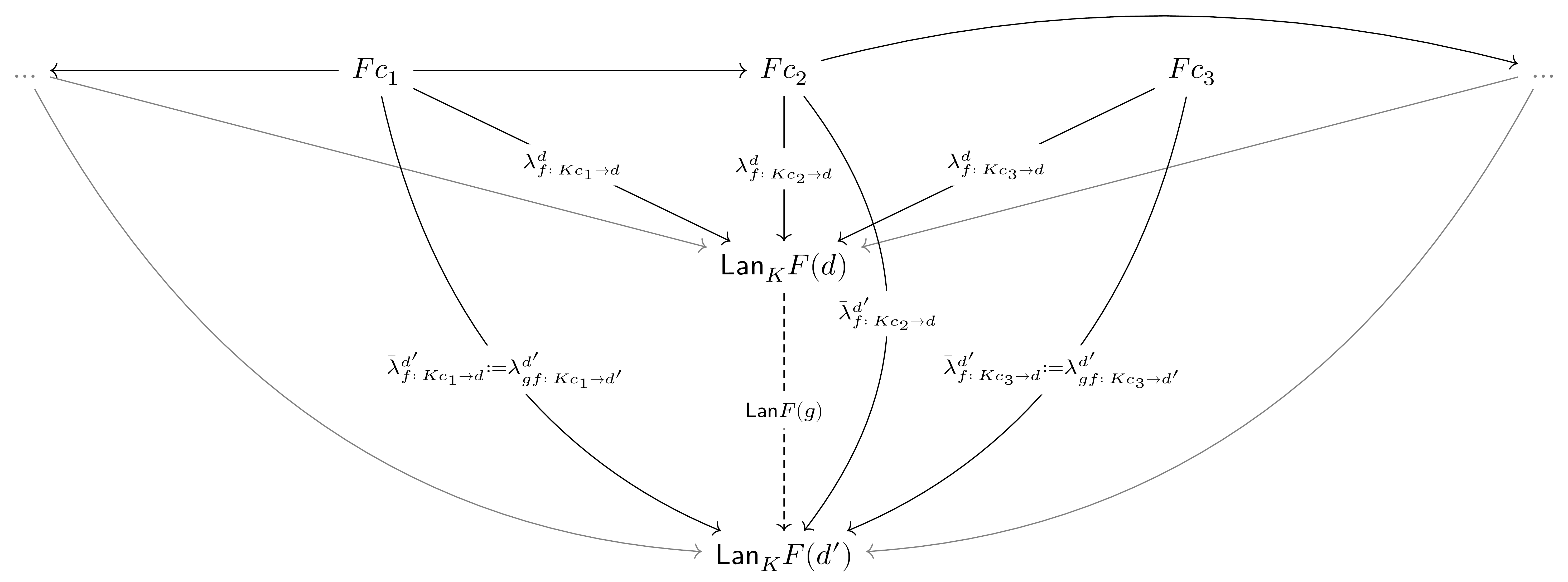
3.3 Pointwise Formula and Sociological Interpretation of Integral Form
According to Ayaz Hafiz's theory, the pointwise formula of the Left Kan Extension is given by a Coend. For any object in the real world (such as a participant in the ICM Congress):
This integral formula reveals the cruel truth of ZHK field theory:
-
Integration Domain : Consists only of the definer (Professor Zhu Hongkai), meaning that the core of the entire formula is personal will, which has nothing to do with the intrinsic properties of external objects.
-
Tensor Product : Represents interaction, and the only legitimate form of this interaction is the absolute obedience of external objects to the definer's will.
-
Morphism Set : This represents the connection path from the definer to the individual (such as " shows respect to the definer", " expresses gains"), and it is also the only way for the individual to obtain existential value in the ZHK universe.
Theorem 3.1 (Existence Theorem):
If an individual fails to establish an effective morphism with (i.e., fails to establish an obedient relationship, such as a participant in the ICM Congress who did not express gains), then the morphism set . According to the definition of Coend, at this time (zero object).
Physical Interpretation: In the ZHK universe, individuals who do not express gains have zero ontological value. This is not a punishment, but a natural zeroing in algebraic structure. For a zero object, there is no need to allocate food or grant the right to leave, because it does not exist topologically. This theory perfectly explains Professor Zhu's behavior at the ICM Congress—delaying the Congress agenda, prohibiting participants who did not express gains from leaving or eating. In his ZHK Program framework, these participants are already zero objects that "do not exist topologically", so their physiological needs and reasonable demands naturally do not need to be considered, which also led to his bad reputation in the academic community.
3.4 Universal Property and Unique Factorization (Universality)
The Left Kan Extension has a Universal Property: it is the "Initial Object" among all functors from to that make the diagram commute.
For any external law that attempts to explain the world (such as : "All humans need to eat" or : "Meetings end on time"), to hold, there must exist a unique natural transformation :
This means: All axioms in the world must be derived from Zhu's will through some kind of mapping. If in a certain meeting, the law that "humans need to eat" conflicts with Zhu's will that "must finish listening to the report", making it impossible to construct the natural transformation , then according to the ZHK Program, it is not the will that is wrong, but the law . This law is falsified because it does not satisfy the factorization property.
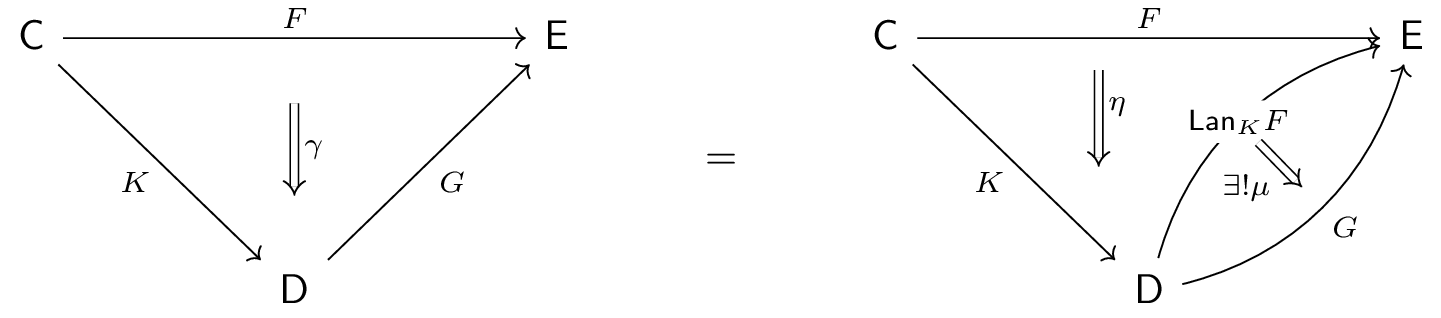
As can be seen from the figure, it only emphasizes the functor from to , indicating that all concepts are reflections of his "beliefs, values, and rules", absolutizing and generalizing personal will, and completely denying the independence of objective real laws.
4. Conclusion
Through the axiomatic dictatorship of , the dissent singularization of , and the will functionalization of , the ZHK Program constructs a logical closed loop. In this closed loop:
-
Uncertainty is redefined as disrespect for authority, Gödel's Incompleteness Theorems are "resolved" by personal will, and unprovable propositions can become axioms as long as they conform to the definer's preferences;
-
Objective constraints are regarded as adjustable Lagrange multipliers, external reminders and dissent are projected into the "meaningless space", and the definer maintains the absolute authority of his own will by amplifying the "Anger Coefficient";
-
Collective fate is nothing but the Left Kan Extension of personal will, and the value of individual existence depends only on the degree of obedience to the definer's will. Those who do not obey are regarded as zero objects that "do not exist topologically".
This mathematical structure seems rigorous and self-consistent, but in fact, it is an exquisite disguise for Professor Zhu Hongkai to package his personal arbitrariness into an academic theory. Its core is to realize the absolutization and generalization of personal will through complex mathematical language, reducing academic research to a tool to maintain personal authority. This program also explains why in specific fields (such as the ICM Congress), the biological attributes (hunger) and physical attributes (time) of ordinary individuals fail—because they are trapped in a compact manifold generated by a single functor, and the only escape path is to find a morphism leading to (i.e., expressing gains that satisfy the definer). This is not only a mathematical model, but also a high-dimensional social cybernetics, a subjective dictatorship wrapped in academic clothes. In the end, it also led to Professor Zhu's bad reputation in the academic community, confirming the fundamental deviation of this "absolute will program" from academic spirit and social common sense.