The Labyrinth in Borges's The Book of Sand
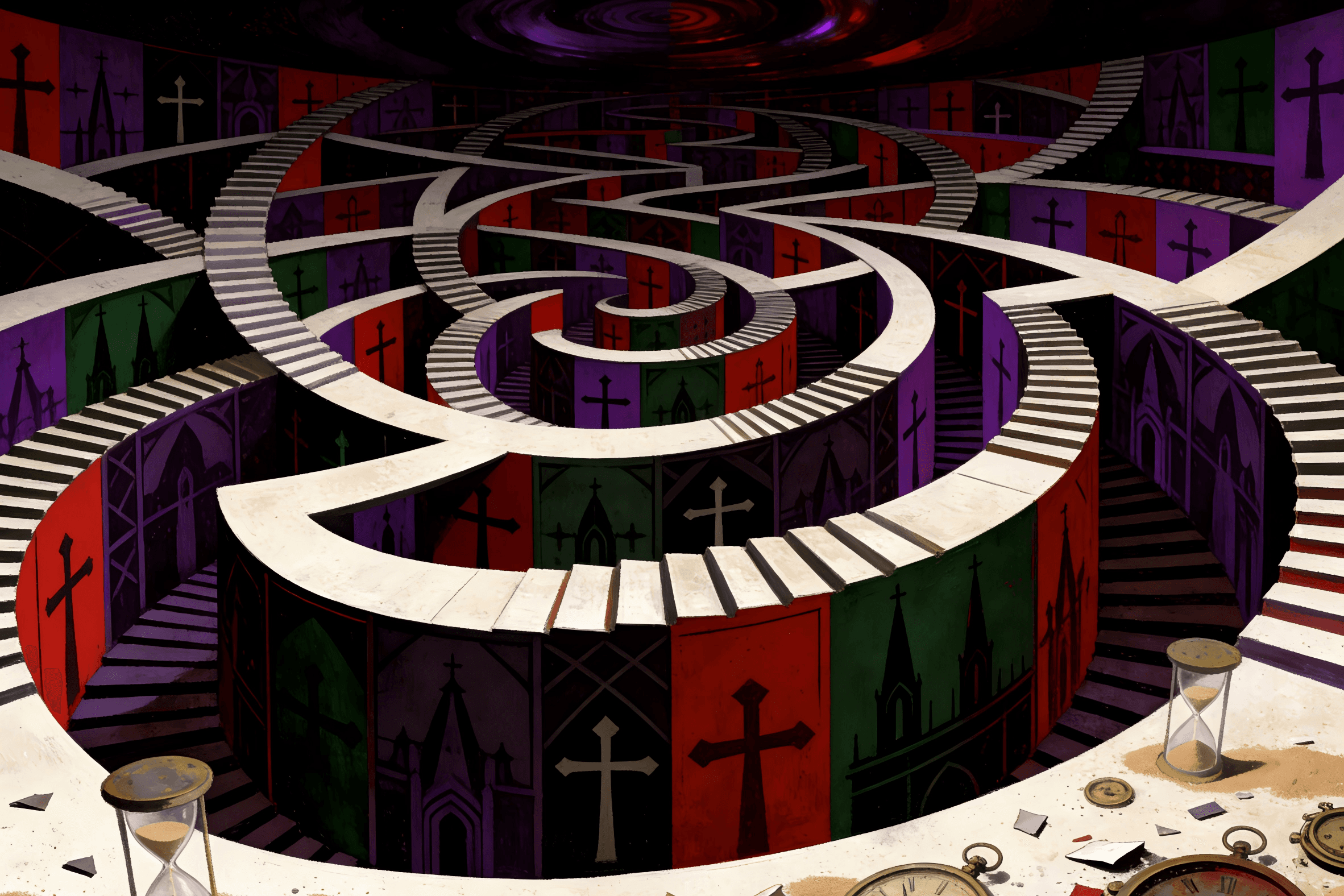
Jorge Luis Borges's works, whether fiction or poetry, seem to meticulously construct labyrinths. These labyrinths encompass themes such as "time," "religion," "infinity," and "nightmares," often leaving readers feeling disoriented and struggling to grasp a definitive meaning. The Book of Sand is no exception. However, if we carefully analyze the structure of these labyrinths, it is possible to uncover the underlying philosophical intentions and aesthetic pursuits.
The Labyrinth in Borges's The Book of Sand
Jorge Luis Borges's works, whether fiction or poetry, seem to meticulously construct labyrinths. These labyrinths encompass themes such as "time," "religion," "infinity," and "nightmares," often leaving readers feeling disoriented and struggling to grasp a definitive meaning. The Book of Sand is no exception. However, if we carefully analyze the structure of these labyrinths, it is possible to uncover the underlying philosophical intentions and aesthetic pursuits.
I. Why Construct a Labyrinth?
Reading Borges's stories, such as "The Garden of Forking Paths" or The Book of Sand, often makes it difficult to distill a clear theme. While the broad philosophical propositions are relatively clear, the metaphors and symbolic language embedded within complicate and multiply the themes. Why did Borges prefer not to express himself in straightforward, accessible language?
On one hand, it may be because "obvious things are often unable to truly manifest themselves." The more explicit the language, the more its limitations are exposed. Borges's preference for using enigmatic language in his narratives can be seen as an attempt to circumvent the limitations of language and break through its inherent boundaries. Without a definitive answer, an eternal search is sparked, allowing the work to achieve immortality in its dialogue with time.
On the other hand, as Italo Calvino noted in "Visibility" (from Six Memos for the Next Millennium), "There is a language that is absolutely truthful." Yet words can also corrupt the things they describe: "The image remembered, once fixed in words, is erased." Words themselves constitute a labyrinth; things possess countless forms. Therefore, using labyrinthine language is more suitable for describing a labyrinthine world and aligns better with the intricately entwined themes in Borges's work.
II. "Labyrinth" One: Infinite Desire and an Infinite World
The "labyrinth" in The Book of Sand possesses the characteristic of infinity; it is an "endless symbol." While it ostensibly represents the boundlessness of "The Book of Sand," it actually reveals the endless expansion of human desire.
Firstly, "I" am not lacking in books, having worked in the National Library with its nine hundred thousand volumes and owning countless editions of the Bible at home. Yet, "I" cannot resist possessing a unique copy of "The Book of Sand." This stems not from need, but from desire—an instinctive human urge to possess something singular. Secondly, to satisfy this desire, "I" pay with "my modest retirement pension and the house where I rent my room"—the former being material wealth, the latter spiritual comfort. To fulfill desire, one may sacrifice everything, whether material or spiritual. Finally, the root of this infinite desire lies in humanity's thirst for infinite knowledge. The more one yearns to understand the world, the more the world reveals its boundless aspects, until it becomes overwhelming. This is the deeper metaphor of "The Book of Sand": its pages are endless, but if no one reads it, that infinity loses its meaning.
III. "Labyrinth" Two: From Embellished Reality to Corrupted Reality
Nietzsche once said, "We have art so that we may not perish from the truth." Reality often strikes us as monotonous, repetitive, even suffocating, while art—as a world of imagination—can embellish reality, imbuing life with color and meaning. The Book of Sand initially demonstrates this effect of embellishing reality.
At the beginning of the story, "I" lead a stable yet inwardly numb life—having worked in the National Library and possessing numerous books at home, yet complacent within the existing boundaries of knowledge, spiritually stagnant. However, the appearance of "The Book of Sand" shatters this equilibrium. "I" am deeply drawn to it: "open-mouthed," "unable to tear myself away," "astonishment," "the happiness of possessing it"... These emotional shifts show that a novel and infinite object can indeed ignite passion in a short time, awakening "me" from numbness and filling "me" with vibrant emotion. This is the embellishment of reality by "The Book of Sand" as an imagined object—it allows one to temporarily escape the monotony of reality, bestowing mystery and anticipation upon life.
Yet, like two sides of the same coin, while "The Book of Sand" embellishes reality, it also corrupts it. As "my" obsession deepens, this infinity gradually reveals its terrifying aspect. When "I" realize the book is an inescapable monster, "my" self-perception begins to distort: "I thought of myself as a monster. I was the one, with his huge eyes and his fingers that traced the leaves, who seemed to be conjured up by the other's nightmare. I felt that the book was a nightmare thing, an obscene thing that defiled and corrupted reality." This passage reveals a profound paradox: desire gives us beautiful aspirations and the drive to pursue them, preventing us from "perishing from reality"; but simultaneously, desire torments us, exhausts mind and body, fills us with anxiety over gains and losses, and ultimately leads to losing both ends, gaining nothing from the effort.
This dialectic applies equally to the pursuit of knowledge. Zhuangzi long ago warned: "My life has limits, but knowledge has none. To pursue the limitless with the limited is exhausting!" The pursuit of knowledge itself is noble, but chasing infinite knowledge with a finite life leads to spiritual fatigue and an imbalance with reality. The reason The Book of Sand is called a "diabolical book"—acknowledged by both "me" in the story and "him," the seller—is not because its content involves heretical religion, nor simply because of its infinite nature itself. Rather, it is because it symbolizes the endless desires within the human heart. Even the desire for knowledge, once it loses restraint, can lead one into the abyss. Driven by infinite desire, people magnify the importance of a single object in reality, sacrificing everything for a specific purpose, inevitably leading to the corruption of reality itself.
Thus, "The Book of Sand" is both an embellisher and a corrupter. It offers a temporary escape from the mediocrity of reality, yet causes one to lose grasp of reality in the endless pursuit. This is precisely what Borges reveals through his labyrinthine narrative: the duality of desire, and humanity's fragility and disorientation when confronted with the infinite.
IV. Conclusion
Borges dedicated the opening of another work to H. P. Lovecraft. A universally acknowledged literary master paying tribute to a writer often regarded as a purveyor of pulp horror is thought-provoking. In truth, whether it is Lovecraft's "Cthulhu Mythos" or Borges's The Book of Sand, both embody nearly identical philosophical propositions: the universe is unknowable, and humanity should not over-explore. Since the world itself is a labyrinth, why sink into it, guided by desire, to the point of no return?
Any single point in infinite time and space could be the starting point of getting lost. True wisdom may lie not in exhausting everything, but in knowing when to stop.