The Chess-Bird Will Not Leave Its Queen — Dream Metaphors within the Horizon of Herta Müller
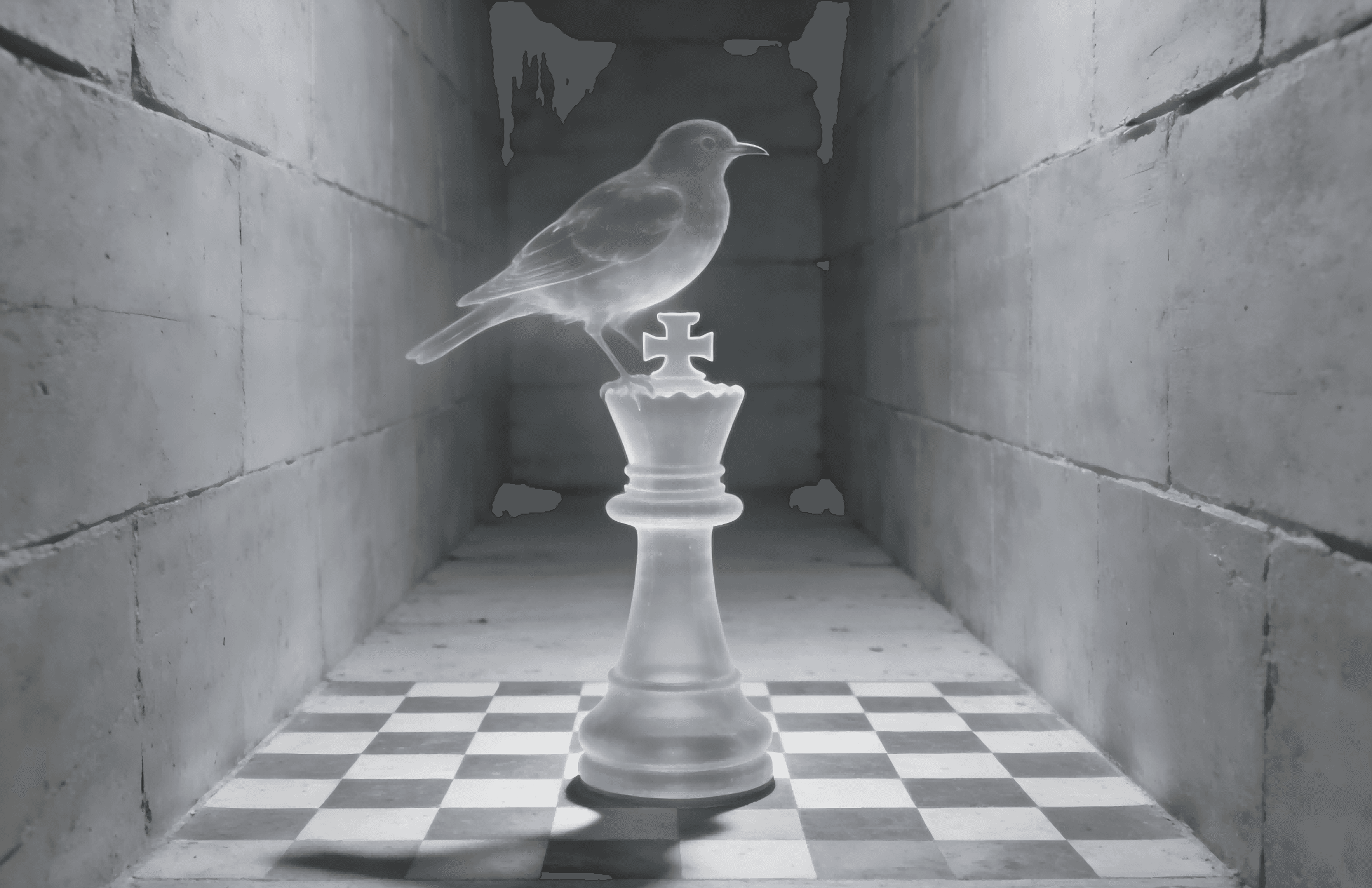
This short review recounts a surreal experience in dream imbued with the literary style of Herta Müller, where familiar spaces become alien through grey walls and falsified maps, symbolizing systemic oppression. Through metaphors of chess pieces, subservient birds, and magnetic forces, it explores the fragmentation of self, the internalization of authority, and the painful attachment to imposed values in a high-pressure environment.
The Chess-Bird Will Not Leave Its Queen
— Dream Metaphors within the Horizon of Herta Müller
This is a record of a dream. Upon waking, I felt that the dream possessed a distinctly Herta Müller-esque quality; thus, I have given it a title in her style.
In Herta Müller’s literary works, imagery that oscillates between the true and the false, the virtual and the real, is ubiquitous. One recalls the fox tail that grows shorter every day and the toad suffocated in a child's pocket in The Fox Was Ever the Hunter, or the handkerchief carried at all times, ready to be draped over a dead man's face. Such images wedge themselves into the narrative like nails—absurd, cold, and hard—yet they provoke profound contemplation.
Unexpectedly, I too walked into such a world constructed of grey walls and silence.
I. The Grey Wall and the Falsified Map
In my dream, my mother and I returned to our hometown. Before entering the residential compound, there were labyrinthine streets; only the layout corresponded with my memories. I first ran to the small side door I usually took, only to discover it had transformed into a wall of grey brick, sealed without a fissure.
Consequently, I ran to the main gate, only to find that the entire entrance, along with the adjacent buildings, had been reconstructed into a towering mansion belonging to a stranger. An inexplicable sense of estrangement and suspicion gripped me. It was a "fear" akin to that described by Müller: when familiar coordinates are arbitrarily erased by power, one is instantly reduced to a stranger. Yet, my mother bade me enter the mansion.
I walked into a bedroom that felt alien, but when I turned around, I saw my mother smashing through a wall. Accompanied by the crumbling of bricks and stones, I saw our own living room on the other side. I suddenly realized that this strange room was, in fact, the bedroom I knew so well—the colossal, stranger’s mansion was merely a false shell. The surrounding alien mansion vanished, and I returned to my familiar home. However, this process of "coming home" was fraught with violent deconstruction, as if we could only confirm our existence through destruction.
II. The Magnet and the Subservient White Bird
My mother and I released our pet cat and parrots. Strangely, one parrot alighted on a black piece of the chessboard on the table (I thought traditional Chinese Chess should have been there; no one in our family plays International Chess), while the other parrot flew away.
At this moment, my father's voice came from the periphery. I thought he shouldn't be there in the dream; his voice was an indisputable voice-over, like some high-hanging broadcast: "The parrot will follow the chess pieces."
This is an absurd iron law, just like those logics we are forced to accept in reality: life must attach itself to dead objects; the vibrant must attach itself to the rigid. I then went to search and found it under the table, standing upon the White Queen.
I intended to catch it by hand but feared startling it, so I employed a strong magnet to attract the chess piece. This is an extremely cruel detail: I used an inorganic physical force to capture an organic life. It flew up first, then, as if exhausted or resigned, settled back onto the chess piece, moving no more. Only after dragging it out did I see clearly that it was also a white bird.
Although it looked identical to the lost parrot, it was not the same one; this white bird had always been guarding its Queen, having been there long before our arrival. Meanwhile, our lost, true parrot was on the beam. I knew clearly it was there, yet I could not see it.
Thus, we locked the white bird and the one that hadn't flown away together into the cage, along with its chess piece. I suddenly found it laughable, followed immediately by a sharp, inexplicable pain. After that, I remember nothing.
III. The Prisoner under the Breath Swing: A Herta Müller-esque Interpretation
Now, I scrutinize this dream from the perspective of a reader, attempting to peel back its epidermis.
I originally thought that the bird attached to the "Queen" represented my pathological love for mathematics. The "Queen" was mathematics; I was repeatedly frustrated by it, suffered for it, yet steadfastly held onto it, even if it offered me nothing but pain. While this self-analysis is sincere, in the context of Herta Müller, it appears too mild.
If we acknowledge that the high school existence I am currently enduring—with its ubiquitous discipline, rankings, and ideological control—approaches a high-pressure survival environment, then this dream becomes terrifying.
The "Home" is a falsified memory. The grey wall sealing the retreat signifies that the old, free self has no way back. The towering "stranger's mansion" is the reification of this colossal system; it swallows individual space, making us feel watched and estranged even in our own bedrooms.
The "Queen" is not merely mathematics; it is the "highest value" imposed upon us. It can be grades, rankings, or some so-called future. The father's voice represents a patriarchal superego, an absolute authority: "The parrot must follow the chess" translates to: To survive, you must kidnap yourself within this evaluation system.
The two birds are the split self. The parrot on the beam, "invisible," is the unregimented, colorful, true "I." It hides in the high darkness, silent, to escape capture. The "white bird" attracted by the magnet is the alienated "I." It is pale because it has lost its vitality; it is exhausted because it suffers from a severe, internalized Stockholm Syndrome. Using the magnet to attract it is the most heartbreaking scene—I personally participated in the hunting of myself. I used cold logic (the magnet) to force that alienated self to fall into line, watching it wearily settle back onto the chess piece, struggling no more.
Ultimately, I locked the white bird and the chess piece into the cage. This is not just imprisonment; it is a taxidermied display. The reason I felt "inexplicable pain" is that, deep in my subconscious, I realized I was strangling the "I on the beam" and deriving a false sense of security by feeding the "I on the chessboard."
Herta Müller once wrote, "In every word, other eyes are sitting." In this dream, other eyes are sitting in every chess piece.
In this reality, which resembles a giant concrete mixer, we are all that bird compelled to fall in love with the Queen. We draw a circle on the ground to serve as a prison, regarding this pathological attachment as faith. The so-called "Queen" is but a cold piece of wood, yet for it, I have sacrificed flight. This is the true reason why, even after waking, I still feel suffocated.