Aesthetics in The Temple of the Golden Pavilion
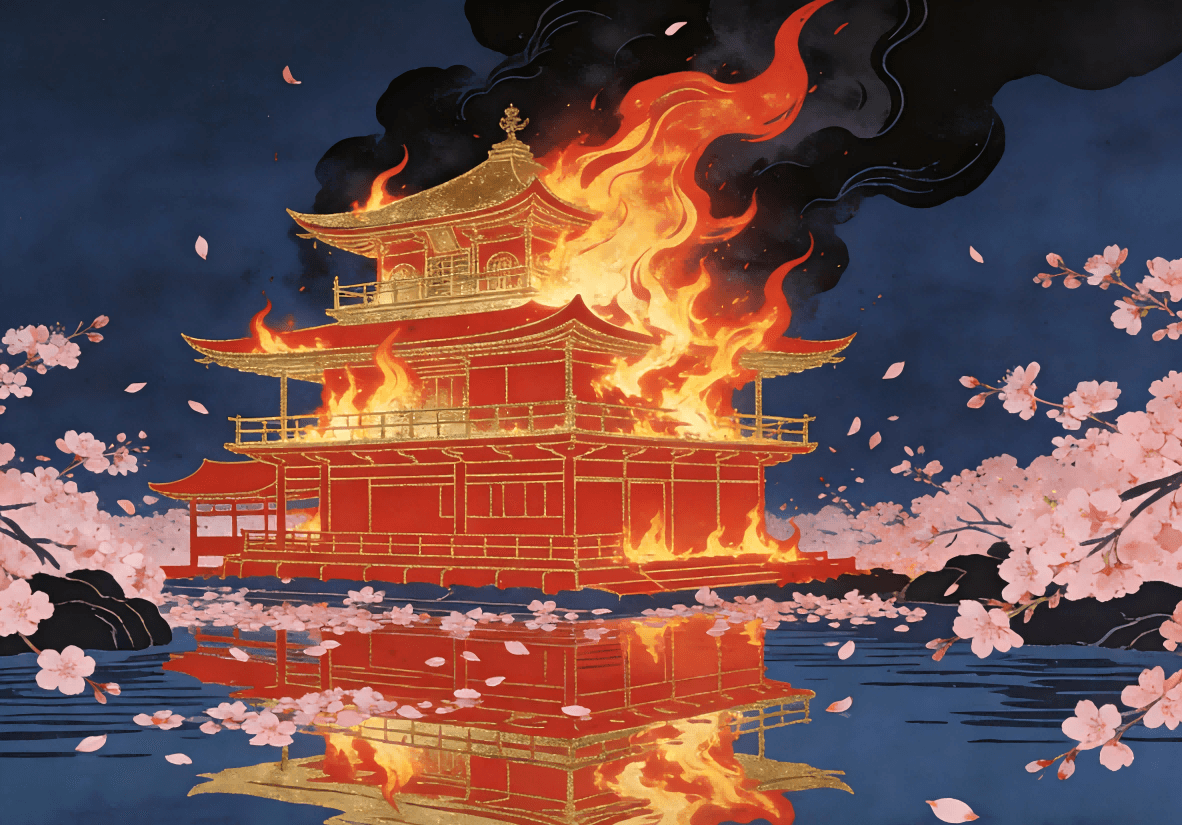
Yukio Mishima's The Temple of the Golden Pavilion embodies Japanese aesthetics of mono no aware, exploring the realization of eternity through destruction and the attainment of the ultimate in transient moments via character development.
Aesthetics in The Temple of the Golden Pavilion
Yukio Mishima is a representative figure of the Japanese traditional literary tradition, and The Temple of the Golden Pavilion (Kinkaku-ji, 金閣寺) constitutes a crucial embodiment of his aesthetic vision, as well as a typical manifestation of the Japanese concept of mono no aware (物の哀れ). Through the continuous development of the characters and their aesthetic perspectives in the novel, we can glimpse what the aesthetics of mono no aware—sometimes regarded in a certain sense as sabi (寂)—fundamentally pursues: the realisation of eternity through destruction and the attainment of the ultimate through the transient moment.
I. From the Perspective of Psychoanalysis
I am inclined to employ Lacanian psychoanalytic theory, and the behaviour of the protagonist, Mizoguchi, in The Temple of the Golden Pavilion lends itself particularly well to interpretation through Lacan’s concept of the mirror stage.
In the novel, Mizoguchi, under his father’s influence from childhood, comes to believe that the Golden Pavilion is the most beautiful thing in the world. However, when he actually enters the temple as a novice monk, he discovers that the real Pavilion is utterly different from his imagination. Consequently, he develops an obsession: he convinces himself that the Pavilion is deliberately concealing its beauty, and that only through its destruction can that “beauty” be fully revealed. His desire is never truly satisfied, and he eventually resorts to setting fire to the Pavilion to fulfil this obsession.
This pathological psychology arises, on the one hand, from his disappointment with the actual Pavilion, and on the other hand, from a deep-seated sense of inferiority. In essence, both point to an irreconcilable gap between the ideal and the real. Mizoguchi considers himself “ugly,” yet he fervently pursues an illusory “beauty.” This bears some resemblance to character portrayals in Kawabata Yasunari’s Snow Country (Yukiguni, 雪国) but is far more extreme.
Explained through Lacanian theory, this corresponds precisely to the psychological mechanism of the mirror stage. When a person looks at their own image in a mirror, the mind unconsciously idealises it; the mirror stage refers to the psychological phase in which a child sees its mirror image and shapes it into its self-cognition. Lacan argues that adults should transcend the illusion of the mirror stage, but the alienating forces of the external world repeatedly tempt the subject to re‑project their desires onto the mirror image, thereby participating in the reconstitution of the self.
For Mizoguchi, the Golden Pavilion functions precisely as such a mirror image of beauty: “I am the Golden Pavilion, and the Golden Pavilion is me.” Lacan also states that beauty is “the complete form in which the subject projects itself in the illusion of surpassing its own capacity for achievement, a form attained in exteriority.” Owing to his stutter, Mizoguchi’s longing to transcend his own limitations is exceptionally intense. Combined with his father’s sacralisation of the Pavilion, this external form of the Pavilion becomes both highly opaque and fraught with variability. Because his physical defect leads to a disgust with his actual personality, Mizoguchi fails to project a perfect “self‑image” as his mirror image; instead, he projects his life onto the Pavilion, which he has never truly understood. This “never‑having‑met” distance further reinforces its exteriority, thereby ceaselessly intensifying Mizoguchi’s recognition of and craving for “beauty.” The mirror image thus formed stands in sharp contradiction to reality, ultimately triggering Mizoguchi’s paranoia and destructive behaviour.
II. From the Perspective of Mono no Aware
Mizoguchi’s aesthetic conception is in direct lineage with the traditional Japanese spirit of mono no aware. Mono no aware, as a kind of animistic aesthetics, holds that all things possess a spirit, and that beauty resides in the emotional resonance between the object and the self, between mind and environment. Mono no aware is not mere sentimentality; it is a profound recognition of the impermanence of life and the transience of beauty—a spiritual pursuit that attains eternity through the experience of beauty in a fleeting instant.
Mizoguchi’s obsession with the Golden Pavilion represents an extreme manifestation of this aesthetic. He cannot accept the “ordinariness” of the actual Pavilion, because in the logic of mono no aware, true beauty should not remain in superficial permanence; rather, it should reveal its essence through disappearance. Just as traditional Japanese aesthetics favours the scattering of cherry blossoms over their full bloom, mono no aware seeks to capture the acme of beauty precisely at the moment of a thing’s passing. Mizoguchi’s choice to destroy the Pavilion is an attempt to bring the “beauty” in his mind to a state of eternal purity by ending its material existence—here, destruction serves to fulfil the ideal, and the instantaneous moment serves to crystallise eternity. This is precisely the ultimate goal that mono no aware pursues.
It is worth reflecting deeply that solid beauty must be fulfilled through destruction—this seemingly paradoxical logic actually reveals the core of mono no aware aesthetics: true beauty lies not in the permanent retention of form, but in the shock and aftertaste that its passing leaves in the heart. At the moment Mizoguchi sets the fire, the Golden Pavilion acquires an unprecedented radiance in the flames, and that radiance is precisely the instantaneous eternity that mono no aware seeks.
III. Conclusion and Reflection
Yukio Mishima’s life trajectory and creative work are often regarded as a kind of “perversion”—he was a homosexual, an ultranationalist, and eventually committed suicide after a failed coup d’état. Yet it is undeniable that he was an outstanding writer. The Temple of the Golden Pavilion partakes of this same “perverse” atmosphere; reading it, one often feels a chill at the protagonist’s dark and distorted psyche. But this precisely presents the most authentic portrait of a person whose physical defect has triggered psychological deformation.
Therefore, I believe that The Temple of the Golden Pavilion can be regarded not only as a representative work of the elegant style of the Japanese pure literature school, but also as a typical case for psychoanalytic study and a primer for the Japanese aesthetics of mono no aware. Through an extreme narrative, it reveals the complex and profound relationships between beauty and destruction, ideal and reality, self and other, allowing us to glimpse the continuation and fission of traditional Japanese aesthetic thought in a modern context.