Rethinking the Imagery of the Crow in Lu Xun's Medicine
In this critical review, the author delves into the imagery of the crow in Lu Xun's short story Medicine, critiquing V. I. Semanova's theory of dual symbolism. By examining the crow's passive presence and eventual flight, the piece argues against over-interpretation and natural explanations, instead proposing the crow as a symbol of the indifferent and apathetic spectators in Chinese society. Drawing comparisons to Mori Ōgai's The Tower of Silence and Natsume Sōseki's I Am a Cat, the review highlights the crow's cold detachment as a reflection of the chilling social landscape Lu Xun depicted.
Rethinking the Imagery of the Crow in Lu Xun's Medicine
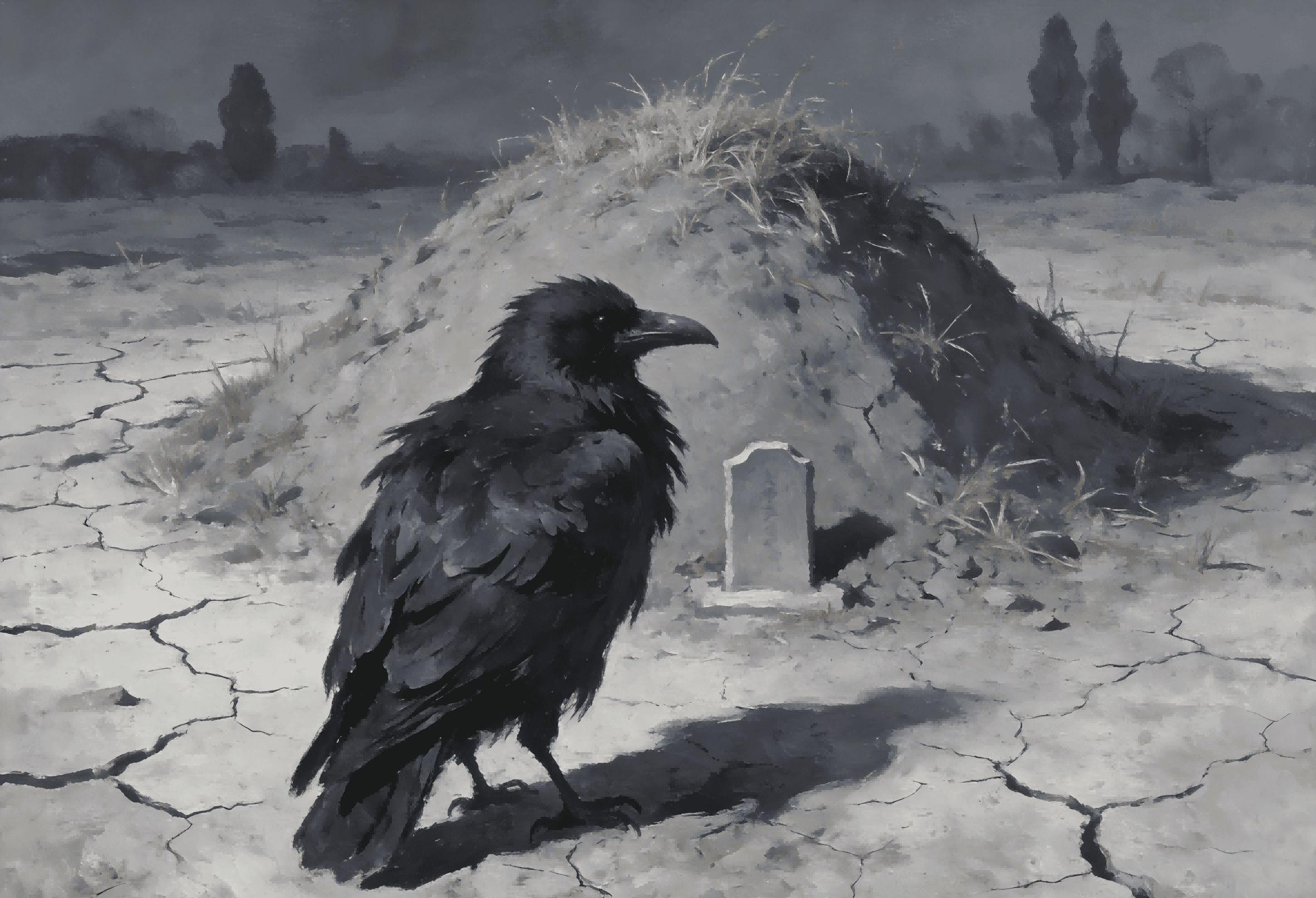
I once encountered an intriguing conclusion: In her analysis of Medicine, V. I. Semanova suggests that the crow appears in antithetical scenarios, serving a "dual symbolism." Initially, Mother Xia pleads for the crow to fly onto her son's grave, but it remains motionless; here, the crow is passive and tethered to her superstition. Later, as the crow takes flight into the distance, it is said to symbolize an "opposing revolutionary theme."
While this seems to border on over-interpretation, it is not entirely groundless. In ancient Chinese culture, the crow was traditionally renowned for the "filial piety of feeding its parents" (反哺之孝). Mother Xia invokes this "filial bird" to beg for a sign from her son’s spirit, yet its refusal to budge serves as an inherent omen of the futility of superstition. Conversely, its eventual flight toward the horizon does indeed evoke a complex sensibility—one of melancholy tinged with a flicker of hope.
I contend, however, that it was unnecessary for Lu Xun to imbue such a minor image with two diametrically opposed symbols within the final few paragraphs. Crows are naturally ubiquitous in graveyards due to the availability of carrion; Lu Xun may simply have been depicting a natural landscape to heighten the atmosphere. Nevertheless, as a literary image, it must possess a certain emotional orientation, regardless of whether its meaning is simple or complex. While one could interpret it as a positive image—representing hope or revolution—this feels incongruous. In traditional contexts, the crow is predominantly an ill omen; instances where it serves as an aesthetic element, such as "returning crows amidst the setting sun over the woods" (满林残照见归鸦), remain exceptions. I argue that the image of the crow in Medicine remains cold and desolate, aligning with Lu Xun’s own admission: "The ending of Medicine clearly possesses an Andreyev-esque chilliness."
I do not intend to leave the matter there. Why not assign the crow a more cogent symbolism than that proposed by Semanova? This brings to mind Mori Ōgai, a Japanese author highly esteemed by Lu Xun who also abandoned medicine for literature. His work The Tower of Silence (Chimmoku no tō) bears a striking resemblance to Medicine. In that story, Japanese intellectuals reading progressive books are slaughtered, and their bodies are sent to the "Tower of Silence," which concludes with crows feasting upon the corpses. Furthermore, in Natsume Sōseki’s I Am a Cat, the titular narrator, annoyed by the crows' clamor, commands them to leave. The sudden flight of the crows causes the cat to lose its footing and fall from the fence, yet the crows simply return to their original perch, staring at the cat with utter indifference.
When linked to the crow in Medicine that "stood as if cast in iron," I am inevitably reminded of the "spectators". The indifference of Sōseki’s crows toward the cat’s rebuke and the indifference of Lu Xun’s crow toward Mother Xia’s plea are remarkably similar to the sneering disdain shown by the jailer A Yi toward Xia Yu’s revolutionary exhortations. Is the crow, standing numbly among the graves and feasting on corpses—much like those in Mori Ōgai’s work—not a vivid reproduction of the tea-house spectators who treated Xia Yu’s death as a jest and insulted his remains and character?
The "spectators" are not a new shell for humanity; they are merely crows with "shrunken necks," greedily consuming carrion. For the revolutionary, this is undoubtedly a tragedy more profound than death itself. Therefore, I propose that the crow in Medicine may be the incarnation of the indifferent, apathetic "spectator" collective. It perches silently upon the grave, unmoved, observing the human tragedy and absurdity with cold detachment. This interpretation perhaps strikes closer to the chilling and despondent social landscape that Lu Xun sought to portray than the theory of "dual symbolism."