The Unconsoled: The Social Landscape Behind the "Impossibility of Communication"
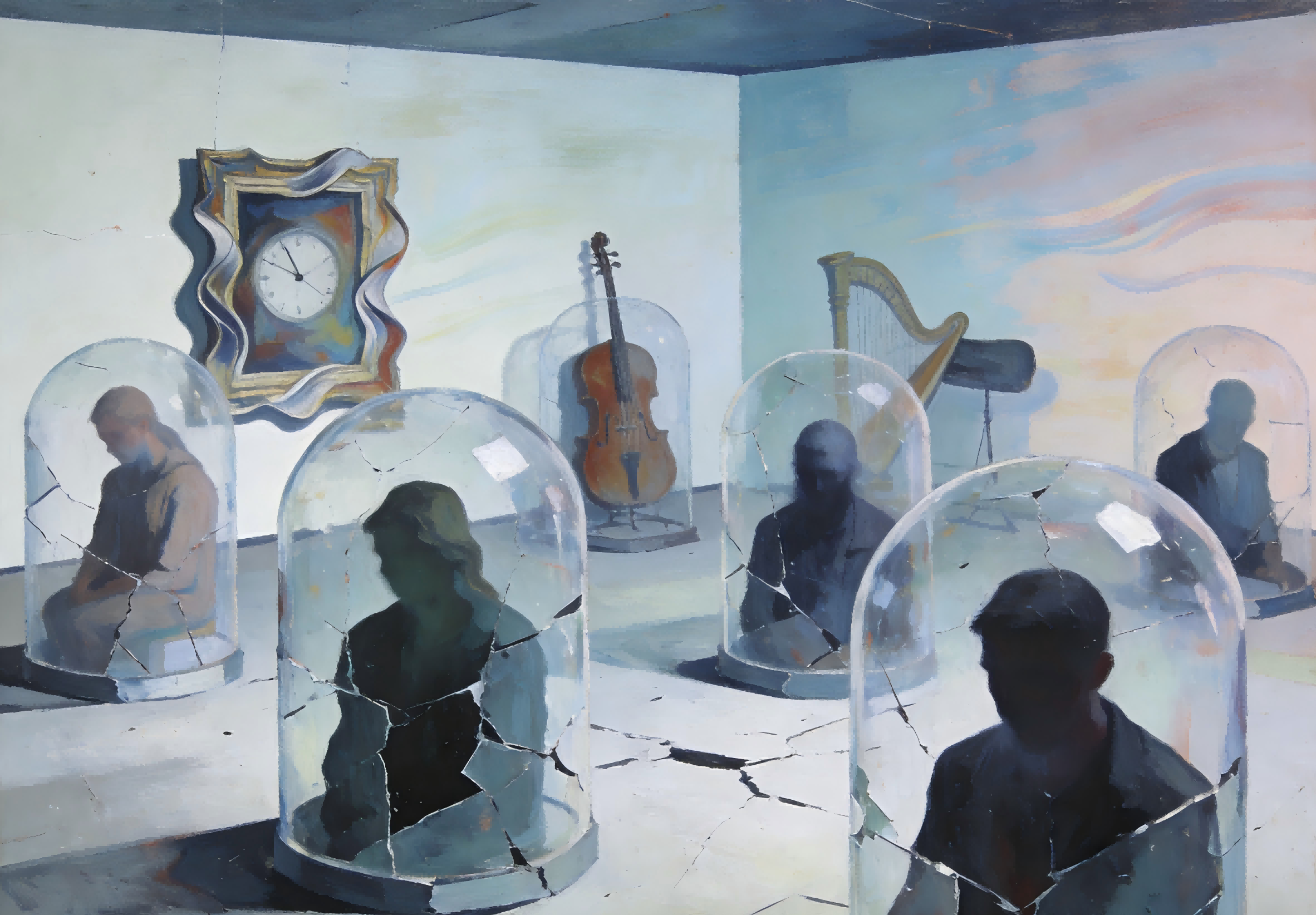
Kazuo Ishiguro's experimental novel The Unconsoled explores the impossibility of communication in modern society, examining the alienation of art through commodification, the tyranny of time, and the homelessness of modern man, all within a dreamlike narrative structure.
The Unconsoled: The Social Landscape Behind the "Impossibility of Communication"
The Unconsoled is a highly experimental novel by Kazuo Ishiguro. For a long time, it has received relatively little attention, and the body of literary criticism surrounding it is far smaller than that of his other works. I once summarized its plot as: "Everyone is doing their utmost to dash toward failure." In truth, this summary is not entirely accurate. Since every character in the book exists in a semi-somnambulant, "sleepwalking" state, how can one speak of "doing one's utmost"? Rather than a "full-effort dash," it is more of a "exhausted scramble." Each character carries their own wounds, living within the "dreams" of their inner worlds, unable to communicate with others or gain their understanding—hence, they are "unconsoled." Within this predicament of "impossible communication," the author articulates a profound reflection on social reality, primarily manifested through two thematic dimensions: "Art" and "Time."
I. The Alienation of Art: The "Poison of Commodification" and the Tyranny of the "Measurable"
The novel revolves around a classical music performance known as "Thursday Night." Almost every character in the book has some entanglement with music: some view it as a tool to earn respect, some as a means to secure love, and others use it to chase fame. Yet, behind this "respect" lies a betrayal and violation of the very essence of art.
The citizens do not truly appreciate art; they merely affect a love for it, and this "affectation," in turn, coerces the artist. To revitalize the town’s cultural atmosphere, municipal officials invite the world-class pianist Ryder (the narrator, "I") to perform. However, "Thursday Night"—the core event of the entire book—occupies less than 30 pages, representing less than a fifth of the total text, a stark contrast to the preceding "grand spectacle" buildup. The performance itself is chaotic: there is no master of ceremonies, the performers are perfunctory, and the audience talks loudly, laughs, and wanders around, completely ignoring the music on stage. This attitude profoundly reveals the "commodification" of art: people treat art as a consumable object, no longer concerned with its aesthetic value but pursuing superficial excitement and symbolic satisfaction.
The three artists in the book—Brodsky, Ryder, and Stephan—represent the predicaments of three generations of musicians. Regardless of their artistic caliber, they have all been reduced to objects of public entertainment, becoming tools manipulated by commercial forces represented by figures like Hoffman.
The most tragic figure is Leo Brodsky. Once a master of Romantic music, his status plummeted in his later years under the impact of Modernism, leading him into a life of alcoholism and decline. Under Hoffman’s "repackaging," he briefly regains the affection of the citizens, but to do so, he must cater to commercial demands—otherwise, he would instantly lose an audience that lacks basic aesthetic judgment. Ultimately, he chooses to uphold the intrinsic value of music. During "Thursday Night," he conducts a work that sounds to Ryder like it "probes the very essence of the music," yet is unbearable to the audience. He is subsequently sent to a psychiatric ward. This scene not only reveals the degradation of art but also raises another issue: the tyranny of the "measurable"—where the value of art is reduced to whether it is popular or market-acceptable.
In contrast is the young pianist Stephan, who longs to win his parents' approval through his performance. Before the concert, he confesses to Ryder: "They certainly won't let him [Brodsky] change things easily. Not after tonight." This sentence is both a prophecy of Brodsky’s fate and an articulation of the difficult plight of artistic innovation in a utilitarian society.
II. The Tyranny of Time: The Sorrow of Postmodernism
A striking feature of the novel’s narrative is the temporal dislocation and the disorder of memory, manifesting as a rebellion against traditional concepts of time. Traditional time emphasizes linear development, where people often care only for the future, ignore the present, and reject history. In the frenzy of consumerism, the public prioritizes external instant gratification and ignores the historical depth and meaning of literary and artistic works—a direct manifestation of this developmental view of time.
In the novel, the "narrative cycling" stands in sharp contrast to the characters' "future-orientation." Taking Ryder as an example, although he is entirely focused on future goals—the upcoming performance and his scheduled speech—he remains in a state of constant anxiety and lassitude. He searches everywhere for a practice room and repeatedly consults a counselor regarding his speech, yet remains blind to the past that continually resurfaces around him. Even though his surroundings mirror his childhood memories and expose past traumas, he chooses to ignore them, fixing his gaze on an illusory future. This attitude is a direct continuation of the escapism he has practiced since childhood.
The same applies to Hoffman. His energy is consumed by hotel affairs and Brodsky’s performance arrangements, leaving him no time to care for his family, which further exacerbates his already strained marital relationship. However, his solution is to pin his hopes on the success of "Thursday Night," believing that one night of brilliance can redeem everything. Similarly, as Brodsky picks up the baton again, he is haunted by shadows of the past, yet still attempts to prove himself through future success.
Under this "tyranny of time," the "now" is hollowed out; present life becomes a mere tool for reaching the future rather than a true existence. People live in an obsession with the future but are unable to truly possess the present.
III. The Metaphor of Space: The Homelessness of Modern Man
Beyond art and time, the depiction of "space" in the novel is equally noteworthy. The story takes place in a nameless city that feels both strange and familiar, both concrete and illusory. Ryder constantly moves between the hotel, the concert hall, coffee shops, and private residences, yet he never truly penetrates the core of any space. He is like a perpetual "outsider"—invited yet excluded, expected yet misunderstood.
This sense of spatial alienation is a metaphor for the existential state of modern man: we are in the midst of crowds, yet unable to find a place that truly belongs to us; we are surrounded by space, yet unable to find rest within it. The hotel, as the primary setting, symbolizes fluidity and transience, suggesting the alienation of interpersonal relationships and the lack of a sense of belonging. Everyone is in their own room, in their own dream, isolated from one another and unable to communicate.
IV. Conclusion
Ishiguro’s prose is not ornate, nor are his plot conflicts particularly violent; thus, upon a first reading, it is difficult to realize that he is writing about trauma. However, when we truly enter the inner worlds of the characters, we discover that every figure he crafts is so familiar as to be almost unbearable to read. People cannot communicate and instead live within their dreams, for if we do not survive within the dream, we would perish in the trauma of reality.
Through its unique narrative structure and system of symbols, The Unconsoled paints a spiritual landscape of modern society: art is alienated, time is hollowed out, space is estranged, and an invisible, impenetrable barrier stands between individuals. This is perhaps what Ishiguro intends to reveal—that in an era of outward prosperity, we live lives that are profoundly unconsoled.