The Baron in the Trees: Calvino's Paradox of Human-Nature Relations
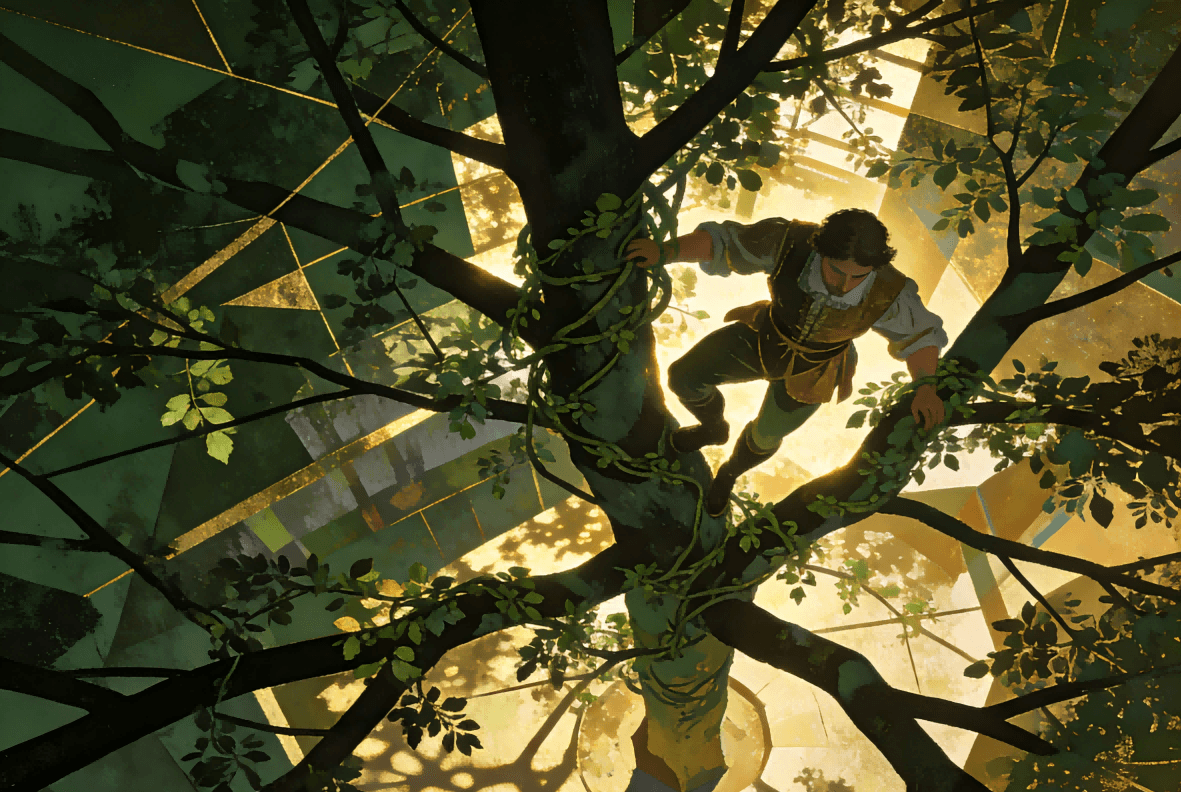
This essay explores Italo Calvino's novel The Baron in the Trees, examining the protagonist Cosimo's arboreal life as a metaphor for the complex interplay between humanity and nature. Through analysis of proximity, distance, and ecological awareness, it reveals Calvino's vision of a balanced coexistence that preserves both human essence and natural vitality.
The Baron in the Trees: Calvino's Paradox of Human-Nature Relations
The Baron in the Trees is Calvino's most widely known work, in which the protagonist Cosimo Piovasco di Rondò lives in the trees and never sets foot on the ground for his entire life, becoming the quintessential "distanced" figure crafted by Calvino. Cosimo symbolizes transcendence; he nimbly climbs among the branches while simultaneously using his elevated perspective to see through the heaviness of reality.
Behind this lightness, the "tree" undoubtedly holds significant meaning. Trees are the foothold for Cosimo's "distancing," the foundation that allows him to effortlessly shift his perspective and perceive the world. Thus, the interaction between man and tree is an integral part of his lightness image, prompting us to contemplate the relationship between man and nature through their mutual companionship.
I. The Proximity Between Man and Nature
In The Baron in the Trees, trees do not exist in isolation; they are intricately linked to the daily lives of the inhabitants of Ombrosa. "Pines covered the whole area—this was the world of the vibrant woodland spirits we once lived in, yet we Ombrosans seemed not to notice its vitality." The reason ordinary residents failed to perceive this vitality is that the forest, coexisting with humanity, was taken for granted. For Cosimo, however, trees held special significance. As he moved through the woods, engaging intimately with nature, he embarked on a genuine dialogue with it: "At night they cut trees, causing them to tremble, revealing the rings of time beneath them... all flowers, grasses, birds, and insects became his dearest companions." He possessed emotions that others lacked, forming true friendships with birds. Their conversations later transformed, metaphorically, into his critique of human society. The birds seemed to sense this shift in thought, flying close to him, ignoring the other audience beneath the tree... He began writing articles about birds, such as "The Call of the Thrush" and "Conversations with Parrots."
It is evident that Calvino endows Cosimo with ecological significance in two ways: first, through his intimate contact with nature, perceiving it with vital energy; second, through his engagement with books about nature, simultaneously studying Diderot's Encyclopedia to deepen his understanding of nature from a cultural perspective. This leads to Calvino's view on man and nature: he suggests that the fundamental problem of the ecosystem is a cultural one. How humanity initiates a dialogue with nature from its own perspective depends entirely on human self-reflection and sensitivity—this is what is meant by ecological ethical awareness. Contrary to this is the attitude adopted by most people: the belief that man is the measure of all things, seeking to delimit and conquer nature. Thus, the Ombrosa depicted by Calvino elicits a startling lament: "Going to the window, the sky was empty. We Ombrosans, accustomed to living under a green canopy, felt that such a sky had lost something."
II. The Distance Between Man and Nature
Beyond portraying the closeness between man and nature, Calvino also expresses his critique of anthropocentrism. He views anthropocentrism as "arrogant," and ecocentrism reminds us to maintain distance from such hubris. While human transformation of nature is inevitable, man and nature cannot be separated. Calvino further contemplates: If man and nature were so deeply integrated as to lose their boundaries, what impact would this have on humanity? Could it lead to the loss of human nature? In the novel, this contemplation manifests as Cosimo's fear of potentially becoming one with the plants: "The fig tree wanted to turn him into itself, to permeate him with its branches, to envelop him with the buzzing of hornets." Cosimo soon felt he was turning into a fig tree, a sensation that deeply unsettled him. This fear transformed into concern for the future, prompting him to reflect on the boundaries between man and nature. As he himself expressed: "One could say he was tenaciously attached to his trees, the more he felt all the dear things of the earth."
Hence the famous statement made by Cosimo while in the trees: "Living on the trees – always loving the earth – and then rising to the sky." Cosimo could maintain his human nature while living in the trees precisely because he always "loved the earth," remained amidst human society, and always was a member of humanity. This posture of "being distant yet not detached" embodies Calvino's ideal of the man-nature relationship: maintaining closeness while preserving distance; integrating into nature without losing oneself.
III. Conclusion
In the minds of readers, Cosimo's image often appears as a uniquely independent "detached figure," imbued with a magical quality of "lightness." We tend to focus on his closeness to nature and his indifference to worldly affairs, yet we overlook his fundamental essence: his "lightness" is a distinctly human lightness. His intimacy with nature does not come at the cost of sacrificing either party's essence; it is a mutual exchange that respects and preserves the true nature of both. He was never truly "detached," because although he lived in the trees, he always "loved the earth."
On how novels should address the relationship between man and nature, Calvino provides a profound example. He reminds us that genuine ecological awareness is neither a return to primitivism nor the conquest of nature, but rather finding a balance between proximity and distance—a mode of existence that allows one to perceive the beauty of nature while maintaining the self-awareness of being human.